The Complete Guide to AI-Assisted Development in 2026: From Vibe Coding to Production Mastery
The Complete Guide to AI-Assisted Development in 2026: From Vibe Coding to Production Mastery
Estimated reading time: 15 minutes
Table of Contents
- Introduction: The AI Coding Revolution
- Part 1: Understanding Vibe Coding
- Part 2: The Productivity Paradox
- Part 3: The Modern AI Coding Toolkit
- Part 4: The Observability Gap
- Part 5: Practical AI-Assisted Workflows
- Part 6: Team and Enterprise Considerations
- Part 7: The Future of Development
- FAQs: 15+ Common Questions Answered
- Resources and Further Reading
Introduction: The AI Coding Revolution
We are living through the most significant transformation in software development since the invention of high-level programming languages. In 2026, the question is no longer whether to use AI in your development workflow—it's how to use it effectively while avoiding the pitfalls that have caught so many teams off guard.
The statistics tell a compelling story of rapid adoption:
| Metric | Value | Source | |--------|-------|--------| | Developers using AI tools | 84% | Stack Overflow 2025 | | Average AI-generated code share | 41% | Stack Overflow 2025 | | Daily AI tool users | 51% | Stack Overflow 2025 | | Developers using GitHub Copilot | 68% | Stack Overflow 2025 | | AI adoption in professional development | 90% | DORA Report 2025 |
But beneath these impressive adoption numbers lies a more nuanced reality. The same developers who are enthusiastically embracing AI tools are also grappling with unexpected challenges: code that's "almost right but not quite," a growing trust deficit, and a productivity paradox that has surprised even the most optimistic researchers.
This guide will take you through the complete landscape of AI-assisted development in 2026—from the philosophical shift of "vibe coding" to the practical realities of debugging AI-generated code. Whether you're a junior developer trying to understand this new paradigm, a senior engineer evaluating tools for your team, or a CTO making strategic decisions about AI investment, this comprehensive resource will give you the knowledge you need.
Part 1: Understanding Vibe Coding
The Birth of a Movement
In early 2025, AI researcher and former Tesla AI director Andrej Karpathy introduced a term that would quickly capture the zeitgeist of modern development: vibe coding. The concept was so resonant that by December 2025, Collins English Dictionary named it their Word of the Year.
But what exactly is vibe coding?
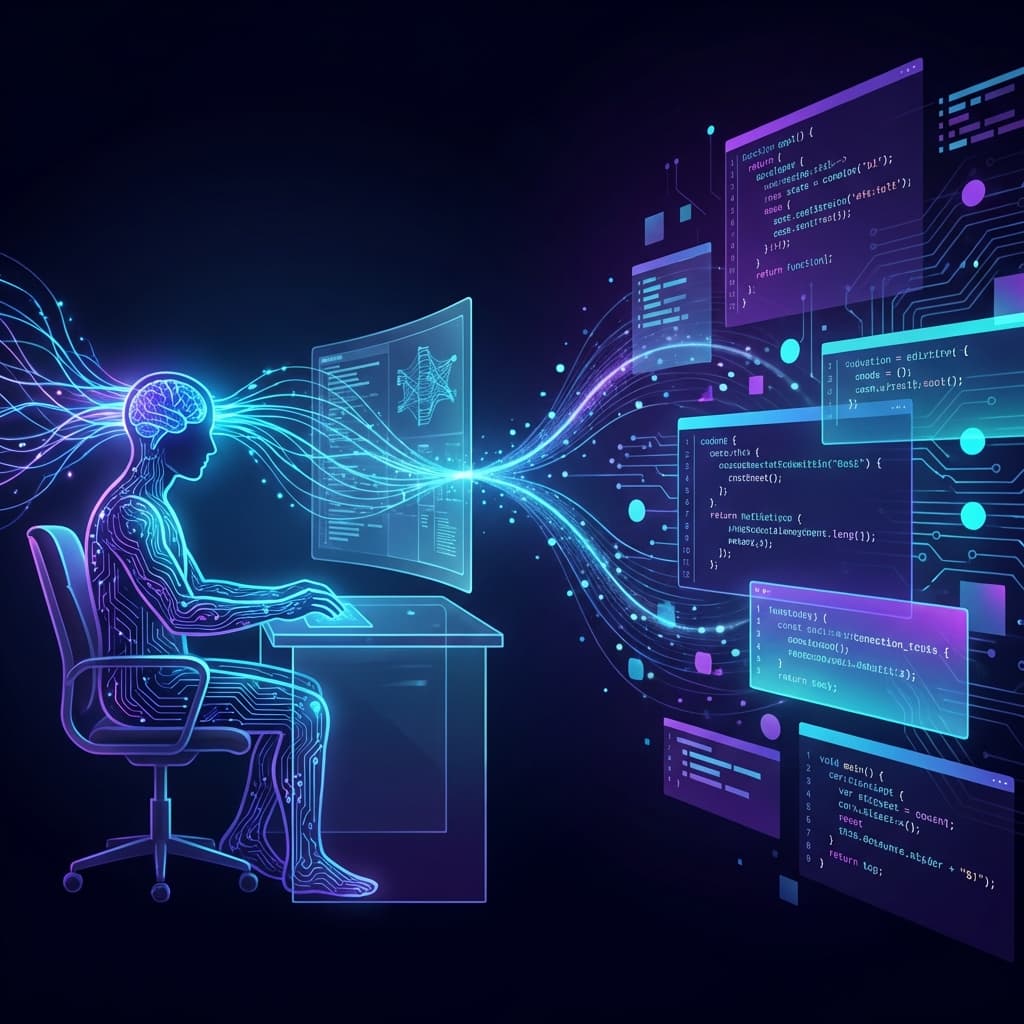
At its core, vibe coding represents a fundamental shift in the developer's relationship with code. Instead of meticulously crafting each line of syntax, developers describe their intent—the "vibe" they're going for—and let AI handle the implementation details.
"The computer is no longer just a calculator; it's a collaborator that understands your intent." — The era of vibe coding
From Syntax to Semantics
For decades, the barrier to entry in software development was syntax. You had to memorize APIs, understand language quirks, fight with semicolons, and master the intricate dance of memory management. The technical knowledge required to translate an idea into working code was substantial.
Vibe coding inverts this relationship:
Traditional Development:
[Idea] → [Learn Syntax] → [Write Code] → [Debug] → [Iterate] → [Ship]

Vibe Coding:
[Idea] → [Describe Intent] → [AI Generates Code] → [Review/Refine] → [Ship]
This isn't just a minor workflow optimization—it's a paradigm shift. The developer's role evolves from being a "bricklayer" to being an "architect and conductor." You describe the outcome you want, provide context and constraints, and guide the AI toward a solution.
The Accessibility Revolution
One of the most significant implications of vibe coding is its democratizing effect on software development. When the primary skill is no longer memorizing syntax but rather clearly articulating intent, the barrier to entry drops dramatically.
According to Microsoft research, AI tools contribute to reduced cognitive load, with 70% of developers reporting less mental effort for repetitive tasks when using GitHub Copilot. Even more striking, 60-71% of developers find it easier to learn new programming languages or understand existing code with generative AI assistance.
This has profound implications for:
- Career changers who want to transition into development without years of syntax training
- Domain experts who can now build tools for their specific fields
- Junior developers who can learn by seeing AI-generated solutions to their problems
- Non-technical founders who can prototype ideas before hiring engineering teams
The Vibe Coding Workflow
A typical vibe coding session might look like this:
## Developer Prompt
"I need a React component that displays a user profile card. It should show the user's avatar,
name, and bio. When clicked, it should expand to show additional details like their location,
joined date, and social links. Use a smooth animation for the expansion. The styling should
be modern with subtle shadows and rounded corners."

## AI Response
[Generates complete React component with TypeScript, CSS animations, and proper accessibility attributes]

## Developer Review
- Checks that the component handles edge cases (missing avatar, long bio text)
- Verifies animation performance
- Tests accessibility with screen reader
- Adjusts styling to match design system
The key insight is that the developer's value has shifted from writing code to reviewing code, from implementation to specification, from syntax mastery to problem definition.
The Dark Side of the Vibe
But vibe coding is not without its critics—and its genuine pitfalls. When you don't write the code yourself, you may not fully understand it. This creates several risks:
-
The Black Box Problem: AI-generated code can be opaque. You might not know why it works, making it harder to debug when it doesn't.
-
Hidden Complexity: AI might choose approaches that are suboptimal for your specific use case, introducing technical debt you don't recognize.
-
Security Blindspots: Generated code may contain vulnerabilities that aren't immediately obvious without deep review.
-
Skill Atrophy: Over-reliance on AI could erode fundamental programming skills over time.
As we'll explore in the next section, these concerns are backed by real research—including studies that show AI tools can sometimes make experienced developers slower, not faster.
Part 2: The Productivity Paradox
The METR Study Bombshell
In mid-2025, a rigorous field study by METR (an AI research organization) sent shockwaves through the developer community. The study, which involved experienced open-source developers using state-of-the-art AI tools like Cursor Pro and Claude, revealed a startling finding:
Developers using AI tools took 19% longer to complete tasks than those who didn't.
This was the opposite of what everyone—including the developers themselves—expected. Before the study, the participating developers predicted they would be 24% faster with AI assistance. After completing the tasks, they still believed they had been 20% faster, even though the objective measurements showed they were nearly a fifth slower.
| Metric | Expected | Perceived | Actual | |--------|----------|-----------|--------| | Productivity change | +24% faster | +20% faster | -19% slower |
This "productivity paradox" has profound implications for how we think about AI coding tools.
Why Does This Happen?
The METR study and subsequent research have identified several factors that explain why AI tools can slow developers down:
1. The Review Overhead
When AI generates code, someone still needs to review it. For experienced developers who deeply understand their codebase, this review process can take longer than simply writing the code themselves would have.
// AI generates this seemingly correct function
function calculateDiscount(price, discountPercent) {
  return price - (price * discountPercent / 100);
}

// But an experienced developer might catch issues:
// - What about negative prices?
// - What about discounts over 100%?
// - Should this return a rounded currency value?
// - Is there an existing utility function for this?
The time spent reviewing, questioning, and refining AI output can exceed the time saved by not writing the code from scratch.
2. The "Almost Right" Problem
According to research, less than 44% of AI-generated code is accepted without modification. Two-thirds of developers find AI solutions to be "almost right, but not quite."
This "almost right" code is particularly insidious because:
- It looks correct at first glance
- It might even work in most test cases
- But it fails in edge cases that the developer would have naturally considered
The result is often more time spent debugging AI-generated code than would have been spent writing correct code in the first place.
3. Context Switching Cost
When you stop to formulate a prompt, wait for AI generation, then parse and evaluate the output, you're constantly context-switching. As we've covered in our article on The Hidden Cost of Context Switching, these switches carry a significant cognitive cost.
The Trust Erosion
Perhaps the most concerning trend is the erosion of developer trust in AI tools. Recent research shows:
- 46% of developers actively distrust AI accuracy
- Only 33% trust AI tool outputs
- Trust has declined by 11 percentage points year over year
This trust deficit creates a vicious cycle: developers who don't trust AI spend more time reviewing its output, which makes the tools feel slower, which further erodes trust.
When AI Actually Helps
Despite the paradox, AI tools do provide measurable benefits in specific scenarios:
Scenario 1: Boilerplate and Repetitive Code
// AI excels at generating repetitive patterns
interface User {
  id: string;
  name: string;
  email: string;
  createdAt: Date;
  updatedAt: Date;
}

// Generate CRUD operations, form validation, API types, etc.
// AI can produce dozens of similar patterns in seconds
Scenario 2: Learning New Technologies
When developers are learning a new framework or language, AI assistance provides a 60-71% improvement in comprehension and speed. The AI serves as an always-available tutor that can explain concepts and show implementation patterns.
Scenario 3: Documentation and Comments
Studies show that AI improves documentation quality by 7.5% for every 25% increase in AI adoption. Writing docs and comments is often a task developers procrastinate on—AI makes it painless.
Scenario 4: Junior Developer Acceleration
The "skill-leveling effect" is real: junior developers see greater productivity improvements from AI than experts. For developers still learning the fundamentals, AI serves as a mentor and accelerator.
The 11-Week Ramp-Up
Microsoft research has identified another crucial factor: it takes approximately 11 weeks for organizations to see meaningful productivity gains from AI tools. This isn't just about learning the tools—it's about developing institutional knowledge about when and how to use them effectively.
Organizations that measure AI ROI in the first month are almost certainly seeing an incomplete picture.
Part 3: The Modern AI Coding Toolkit
The Major Players
The AI coding tool landscape in 2026 is dominated by several major players, each with distinct strengths and philosophies.
GitHub Copilot
Philosophy: Inline suggestions that feel like a more intelligent autocomplete.
Strengths:
- Seamless integration with existing editors (VS Code, JetBrains, Neovim)
- Fast, non-intrusive suggestions
- Strong context awareness from the current file and open tabs
- Enterprise-grade security and compliance features
Best For: Developers who want AI assistance without changing their workflow.
// Copilot shines with inline completions
function fetchUserData(userId) {
  // Start typing and Copilot completes with contextual awareness
  return fetch(`/api/users/${userId}`)  // ← Copilot suggests
    .then(res => res.json())            // ← Copilot suggests
    .catch(err => console.error(err));  // ← Copilot suggests
}
Cursor AI
Philosophy: Conversational, agent-like coding with multi-file awareness.
Strengths:
- Natural language queries about your codebase
- Multi-file editing and refactoring
- "Composer" mode for complex, multi-step tasks
- Built-in AI chat that understands your project context
Best For: Developers who want to treat AI as a pair programmer, not just an autocomplete.
## Cursor Chat Example
User: "Refactor all our API calls to use the new authentication middleware
and add proper error handling with retry logic"

Cursor: [Analyzes codebase, identifies all 47 API calls, generates a diff
showing changes across 12 files, explains the changes]
Claude (Anthropic)
Philosophy: Deep reasoning and extensive context windows.
Strengths:
- 200k token context window (can analyze entire codebases)
- Superior reasoning for complex architectural decisions
- Excellent at explaining code and concepts
- Strong ethical guidelines reduce harmful outputs
Best For: Complex problem-solving, code review, and architectural discussions.
ChatGPT/GPT-4 (OpenAI)
Philosophy: General-purpose intelligence applied to coding.
Strengths:
- Broad knowledge base across technologies
- Image understanding (can read screenshots, diagrams)
- Plugin ecosystem for extended functionality
- Strong at generating tests and documentation
Best For: Multi-modal tasks and developers who work across many technologies.
Specialized Tools
Here are some other notable AI coding tools:
- Amazon CodeWhisperer — AWS integration, ideal for cloud-native development
- Tabnine — Privacy-focused and self-hosted, great for enterprise security requirements
- Codeium — Offers a free tier with multiple language support, perfect for cost-conscious teams
- Sourcegraph Cody — Combines codebase search with generation, best for large codebases
- Replit AI — Browser-based development, excellent for quick prototyping and education
Choosing the Right Tool
The best tool depends on your workflow and priorities:
- Speed/Non-intrusive → GitHub Copilot
- Conversational/Multi-file → Cursor
- Deep reasoning/Architecture → Claude
- Privacy/Self-hosted → Tabnine
- AWS/Cloud-native → CodeWhisperer
- Cost/Free tier → Codeium
The Integration Layer
Modern developers often use multiple AI tools in combination:
- IDE-integrated tool (Copilot/Cursor) for real-time coding
- Chat-based tool (Claude/ChatGPT) for complex problem-solving
- Specialized tool for specific needs (security scanning, test generation)
This multi-tool approach allows developers to leverage the strengths of each system while compensating for individual weaknesses.
Part 4: The Observability Gap
The Black Box Problem Deepens
As AI generates more of our code, a critical gap has emerged: we increasingly don't understand what our applications are doing at runtime.
Traditional debugging assumes you wrote the code and therefore understand its structure. You know where to set breakpoints, what variables to watch, and what behavior to expect. But with AI-generated code, these assumptions break down.
Consider this scenario:
// AI generated this complex data transformation
const processUserData = (users) => {
  return users
    .filter(u => u.status !== 'inactive')
    .map(u => ({
      ...u,
      fullName: `${u.firstName} ${u.lastName}`,
      preferences: normalizePreferences(u.prefs || {}),
      score: calculateEngagementScore(u.activities)
    }))
    .sort((a, b) => b.score - a.score)
    .slice(0, 100);
};
When this fails in production, where do you start? You didn't write it, so you may not immediately understand:
- What
normalizePreferencesdoes to the data - How
calculateEngagementScoreweights different activities - Why filtering by status might exclude valid users
- The performance implications of processing thousands of users
Why Traditional DevTools Fall Short
Browser DevTools are excellent for debugging your code. But they hit limitations with AI-generated code:
DevTools Gaps with AI-Generated Code:
- Understanding unfamiliar code structure — DevTools capability: Limited (High gap)
- Tracing data through complex transformations — DevTools capability: Basic (Medium gap)
- Seeing server-side context — DevTools capability: None (Critical gap)
- Correlating frontend behavior with API calls — DevTools capability: Manual (High gap)
- Inspecting state across the full stack — DevTools capability: Fragmented (Critical gap)
When you didn't write the code, you need tools that help you observe behavior rather than recall it.
Observability as the New IDE
In the vibe coding era, your traditional IDE remains useful for editing code, but your runtime observability tools become your lifeline for understanding it.
This is where tools like DevConsole become essential. Rather than relying on your memory of implementation details, you can:
- See the actual runtime behavior of AI-generated code in real-time
- Inspect network requests and responses without switching to separate tools
- View application state as it changes through complex transformations
- Debug authentication and cookies with automatic JWT decoding
- Correlate frontend and backend behavior in a unified view
The DevConsole Advantage for AI Code
When debugging AI-generated code, DevConsole provides specific advantages. You can explore these in detail in our real-world use cases hub, but here are the highlights:
1. Inline Visibility
Instead of context-switching between your app and DevTools, DevConsole overlays directly on your application:
// Your AI-generated component with DevConsole overlay
<UserDashboard>
  {/* DevConsole shows real-time:
    - Network requests this component makes
    - State changes as data loads
    - Performance timing for each render
    All without leaving your app context */}
</UserDashboard>
For more on reducing context switches, see our article on The Hidden Cost of Context Switching.
2. Full-Stack Tracing
AI-generated code often spans frontend and backend. DevConsole lets you trace requests from component to API to database and back, seeing exactly where things break down.
Check out our Network Explorer documentation for details on waterfall debugging.
3. State Inspection
When AI generates complex state management code, DevConsole helps you understand what's actually happening:
// AI generated this React Query setup
const { data, isLoading, error } = useQuery({
  queryKey: ['users', filters, sort],
  queryFn: () => fetchUsers(filters, sort),
  staleTime: 5 * 60 * 1000,
});

// DevConsole shows:
// - Cache hit/miss status
// - Actual staleTime countdown
// - Refetch triggers
// - Error details with full stack traces
For deep dives into state debugging, see Debug React Query and SWR Cache.
Building an Observability-First Mindset
The shift to AI-assisted coding requires a corresponding shift in mindset:
Old mindset: "I wrote this code, so I understand it. I'll debug through my knowledge of the implementation."
New mindset: "This code exists. I need to observe its behavior to understand what it's doing and whether it's correct."
This observability-first approach has several practical implications:
- Instrument early: Add logging and tracing before problems occur
- Use visual debugging: Tools that show you state graphically are more effective than console.log
- Trace, don't guess: Follow actual data flow rather than assuming based on code reading
- Correlate across boundaries: Problems often span frontend/backend/database
Part 5: Practical AI-Assisted Workflows
Setting Up Your Environment
A productive AI-assisted development environment in 2026 combines several layers:
Development Environment Stack:
  Editor:
    Primary: VS Code or Cursor
    AI Inline: GitHub Copilot or Cursor AI

  AI Chat:
    Complex Problems: Claude 3.5
    Quick Questions: ChatGPT

  Observability:
    Runtime Debug: DevConsole
    Performance: Browser DevTools Performance tab
    Errors: Sentry or similar

  Version Control:
    Code Review: GitHub with AI-assisted review
    Commits: Conventional commits with AI help
The Review-First Workflow
Experienced developers are increasingly adopting a "review-first" rather than "generate-first" workflow:
## Review-First Workflow

1. **Describe the requirement** to AI in detail
2. **Request an explanation** before code generation
3. **Review the approach** and suggest modifications
4. **Generate the implementation** based on approved approach
5. **Review the code** against the agreed approach
6. **Request tests** that cover edge cases
7. **Verify with observability tools** that runtime behavior matches expectations
Compare this to the naive approach:
## Generate-First Workflow (Less Effective)

1. Ask AI to generate code
2. Paste it into your project
3. Hope it works
4. Debug when it doesn't
The review-first workflow takes slightly longer initially but produces significantly better results and fewer bugs.
Prompt Engineering for Developers
Effective prompts share several characteristics:
1. Context Is King
## Poor Prompt
"Write a function to validate email"

## Better Prompt
"Write a TypeScript function to validate email addresses for our user registration form.
Requirements:
- Must support standard email formats and common TLDs
- Should return a tuple of [isValid: boolean, errorMessage?: string]
- Needs to handle edge cases like subdomains and plus signs
- Will be called on every keystroke, so performance matters
- Must match our existing error message formatting in src/utils/validation.ts"
2. Include Constraints
## Specify Constraints
"Generate a React component for displaying paginated data.
Constraints:
- Use our existing <Button> and <Table> components from src/components/ui
- Follow our coding style: functional components, named exports, no default exports
- Include proper TypeScript types
- Handle loading, error, and empty states
- Must be accessible (keyboard navigation, screen reader support)
- Prefer CSS modules over inline styles"
3. Request Explanations
## Ask for Rationale
"Before generating the code, explain:
1. What approach you'll take and why
2. Any tradeoffs in the implementation
3. Potential edge cases to consider
4. Dependencies or utilities this will need"
Code Patterns That Work Well With AI
Some patterns produce consistently better results with AI assistance:
Pattern 1: Type-First Development
// Define types first, then let AI implement
interface UserRepository {
  findById(id: string): Promise<User | null>;
  findByEmail(email: string): Promise<User | null>;
  create(data: CreateUserInput): Promise<User>;
  update(id: string, data: UpdateUserInput): Promise<User>;
  delete(id: string): Promise<void>;
}

// Prompt: "Implement the UserRepository interface using Prisma ORM"
Pattern 2: Test-First with AI
// Write tests first (or have AI write them), then implement
describe('calculateShippingCost', () => {
  it('should calculate domestic shipping based on weight', () => {
    expect(calculateShippingCost({ weight: 1, destination: 'US' })).toBe(5.99);
  });

  it('should calculate international shipping with surcharge', () => {
    expect(calculateShippingCost({ weight: 1, destination: 'UK' })).toBe(15.99);
  });

  it('should apply free shipping for orders over threshold', () => {
    expect(calculateShippingCost({ weight: 5, orderTotal: 100 })).toBe(0);
  });
});

// Prompt: "Implement calculateShippingCost to make all tests pass"
Pattern 3: Component Sketching
// Sketch the structure, let AI fill in implementation
function ProductCard({ product }) {
  // TODO: AI - implement loading state
  // TODO: AI - add to cart functionality with quantity
  // TODO: AI - wishlist toggle with animation
  // TODO: AI - responsive image with lazy loading

  return (
    <article className="product-card">
      {/* AI: implement based on TODOs */}
    </article>
  );
}
Anti-Patterns to Avoid
Anti-Pattern 1: Blind Copy-Paste
// ❌ Never do this
// AI generated this, I'll just paste it and move on
const complexFunction = () => { /* AI code */ };

// ✅ Always do this
// Review, understand, then integrate
const reviewedFunction = () => {
  // I understand what each line does
  // I've verified it handles our edge cases
  // It follows our coding standards
};
Anti-Pattern 2: Over-Prompting
# ❌ Trying to Do Too Much
"Build me a complete e-commerce platform with user auth, product catalog,
shopping cart, checkout, payment processing, order management, admin panel,
analytics dashboard, and recommendation engine"

# ✅ Incremental Approach
"Create a Product type with the following fields: id, name, price, description,
imageUrl, and category. Include validation for price (positive number) and
required fields."
Anti-Pattern 3: Ignoring AI Limitations
# AI is weak at:
- Complex business logic unique to your domain
- Performance optimization for your specific scale
- Security-critical code (auth, encryption, payment)
- Code that requires deep knowledge of your existing patterns

# AI excels at:
- Boilerplate and repetitive patterns
- Standard CRUD operations
- Test generation
- Documentation and comments
- Learning new APIs/frameworks
Part 6: Team and Enterprise Considerations
The ROI Question
For engineering leaders, the question isn't whether to adopt AI tools—it's how to measure and maximize ROI. Current data points to consider:
| Metric | Value | Source | |--------|-------|--------| | Average enterprise AI spending | $85,521/month | Industry research 2025 | | AI spending increase year-over-year | 36% | Industry research 2025 | | Time to meaningful productivity gains | 11 weeks | Microsoft Research | | Developer time lost to tool navigation | 6-15 hours/week | Port.io Research |
The math suggests that if AI tools save even 2-3 hours per developer per week, the investment pays off quickly. But the key is reaching that productivity threshold—which takes time.
For deeper analysis of tooling ROI, see our ROI of Dev Tooling for Engineering Leads.
The 11-Week Implementation Reality
Microsoft's research finding that organizations need 11 weeks to see meaningful productivity gains has important implications:
- Don't measure too early: Evaluating AI tool effectiveness in month one will show misleading results
- Invest in training: The ramp-up period requires active learning, not just tool provisioning
- Create internal champions: Developers who master the tools first can accelerate adoption for everyone
- Build institutional knowledge: Document what works and what doesn't for your specific codebase
Security and IP Considerations
Enterprise AI adoption raises legitimate security concerns:
Security Considerations:
  Code Exposure:
    Risk: Proprietary code may be sent to external AI services
    Mitigation: Self-hosted options (Tabnine), private instances

  Output Licensing:
    Risk: AI may generate code similar to GPL-licensed training data
    Mitigation: Legal review, code provenance scanning

  Secrets Leakage:
    Risk: Developers may accidentally include API keys in prompts
    Mitigation: Secret scanning, prompt filtering

  Compliance:
    Risk: AI code may not meet regulatory requirements
    Mitigation: Mandatory human review, compliance-focused training
Training Developers to Supervise AI
As AI takes on more code generation, the skill of supervising AI becomes crucial. This requires:
- Deep language understanding: You need to know what correct code looks like to spot incorrect code
- Architecture knowledge: AI generates code; humans must ensure it fits the larger system
- Testing mindset: Reviewing AI code means thinking about what could go wrong
- Security awareness: AI may not consider security implications automatically
This has led some organizations to worry about a potential skill erosion if developers rely too heavily on AI for fundamentals.
The Skill Leveling Effect
One consistent finding across studies is that junior developers benefit more from AI than experts:
Productivity Improvement by Experience Level:
- Junior developers (0-2 years): 40-55% improvement
- Mid-level developers (3-6 years): 20-30% improvement
- Senior developers (7+ years): 0-15% improvement (or sometimes slower)
This has implications for team composition and training:
- Juniors can onboard faster with AI assistance
- Seniors become force multipliers by reviewing AI output rather than writing basics
- The gap between experience levels narrows, potentially changing compensation dynamics
- Foundational learning still matters to develop judgment for supervising AI
For more on developer career progression in the AI era, see Junior to Senior: Fast Track with Tooling.
Part 7: The Future of Development
From Generation to Review
One of the most significant emerging trends is a shift in how developers use AI—from generation to review and summarization. Tools that help developers understand and validate code are proving more effective than those that simply generate it.
2024: AI as Code Generator
- "Write me a function that..."
- Focus on speed of creation
- Developers as editors of AI output

2026: AI as Code Reviewer
- "Review this PR and identify issues..."
- Focus on quality and understanding
- Developers as directors of AI analysis
This shift addresses many concerns about the productivity paradox—when AI reviews rather than generates, developers remain in control while benefiting from AI's pattern recognition.
The $169 Billion Trajectory
The AI software industry is projected to reach $169.2 billion by 2032. This scale of investment suggests:
- Continued rapid improvement in tool capabilities
- Consolidation as major players acquire startups
- Increasing integration between AI and traditional developer tools
- Lower barriers to entry for software development overall
Will Developers Become Obsolete?
The short answer: No, but roles will evolve.
Consider the analogy of spreadsheets and accountants. When VisiCalc and Excel automated calculations, accountants didn't disappear—they shifted to higher-level work like financial analysis and strategy. The same pattern is playing out in development.
Evolution of Developer Work:

Traditional Era:
- 70% Implementation
- 20% Design
- 10% Strategy

AI-Assisted Era:
- 30% Implementation/Review
- 40% Design/Architecture
- 30% Strategy/Product
Developers who adapt will find their roles more strategic, more creative, and potentially more fulfilling. Those who resist—or who fail to develop the judgment needed to supervise AI—may struggle.
Predictions for 2027 and Beyond
Based on current trends, we predict:
- AI-generated code will exceed 60% of new code written
- "AI-native" frameworks will emerge, optimized for AI generation
- Observability tools will be considered essential, not optional
- Code review will become AI-assisted at scale
- The productivity gap between AI-adopting and non-adopting teams will widen dramatically
- Junior developer hiring will shift toward those who can learn and adapt quickly
- Technical interviews will include AI-assisted coding sections
The developers who thrive will be those who embrace AI as a tool while maintaining the judgment, creativity, and architectural thinking that AI cannot replicate.
FAQs: 15+ Common Questions Answered
What exactly is "vibe coding"?
Vibe coding is a development approach where you describe your intent in natural language and let AI generate the implementation. Coined by Andrej Karpathy in early 2025, the term captures the shift from syntax-focused coding to intent-focused development. Instead of writing every line, you describe the "vibe" you're going for—the outcome, the feel, the behavior—and AI handles the translation into code. It was named Collins Dictionary Word of the Year 2025.
Why did experienced developers get 19% slower with AI tools in the METR study?
The METR study found that experienced developers faced several challenges with AI tools: (1) The overhead of reviewing and validating AI-generated code sometimes exceeded the time saved; (2) The "almost right" code required extensive debugging; (3) AI suggestions didn't always align with expert developers' understanding of optimal patterns; (4) Context switching between AI interaction and coding disrupted flow states. Essentially, experts had internalized patterns that let them code faster than AI + review time.
How much code is AI-generated on average in 2026?
According to the 2025 Stack Overflow Developer Survey, the average is 41% of code being AI-generated. However, this varies significantly by company, team, and individual. Some developers report generating 70%+ of their code with AI, while others use it only for specific tasks like test generation or documentation.
Which AI coding tool should I use—Copilot or Cursor?
It depends on your workflow preference. GitHub Copilot is ideal if you want fast, inline suggestions that feel like enhanced autocomplete—it works within your existing editor workflow. Cursor is better if you want a conversational, agent-like experience with multi-file awareness and the ability to discuss your codebase in natural language. Many developers use both: Copilot for quick completions and Cursor for complex refactoring or exploration.
Is AI-generated code secure?
Not automatically. AI can generate code that works but contains security vulnerabilities, especially if it learned from code with security issues. Best practices include: (1) Always review AI-generated code with security in mind; (2) Use security scanning tools on AI output; (3) Never use AI for cryptography or authentication without expert review; (4) Be especially careful with AI-generated code that handles user input.
How long does it take to see ROI from AI coding tools?
Microsoft research indicates approximately 11 weeks for organizations to see meaningful productivity gains. The first few weeks often show decreased productivity as developers learn the tools and develop effective prompts. Patience and structured training are essential—organizations that measure ROI in week two and cancel subscriptions are making a mistake.
Do I still need to learn to code if AI can write code for me?
Absolutely. AI is a tool, not a replacement for understanding. You need to: (1) Know enough to recognize when AI code is wrong; (2) Understand architecture to ensure AI-generated pieces fit together; (3) Debug when AI code fails; (4) Handle the parts of development AI can't do well (complex business logic, security, optimization). Think of AI as multiplying your capabilities—if your capabilities are zero, the product is still zero.
What's the "productivity paradox" in AI coding?
The productivity paradox refers to the finding that developers feel more productive with AI tools but may not actually be faster—and in some cases are slower. The METR study showed developers expected to be 24% faster, felt they were 20% faster, but were actually 19% slower. This gap between perception and reality likely comes from the cognitive relief of not having to think about syntax, even when review time exceeds writing time.
How does DevConsole help with AI-generated code specifically?
DevConsole provides runtime observability that's especially valuable for AI-generated code because: (1) You can observe behavior of code you didn't write instead of relying on implementation knowledge; (2) Inline visibility means less context switching between your app and debugging tools; (3) Full-stack tracing helps you understand AI code that spans frontend and backend; (4) Real-time state inspection shows exactly what AI-generated transformations are doing to your data.
What should I include in prompts for better AI code generation?
Effective prompts include: (1) Context about your codebase and coding standards; (2) Specific requirements, not vague requests; (3) Constraints like performance requirements, dependencies, or accessibility needs; (4) Edge cases you want handled; (5) Examples of similar code in your project; (6) Request for explanation before implementation. More specific prompts consistently produce better results than vague ones.
Is AI coding causing "skill erosion" among developers?
This is a legitimate concern without a definitive answer yet. Some developers report feeling less sharp on fundamentals after heavy AI use. The risk is real for developers who use AI as a crutch rather than a tool. Best practices to avoid erosion: (1) Periodically code without AI to maintain skills; (2) Always understand what AI-generated code is doing; (3) Use AI to learn, not just to produce; (4) Focus on higher-level skills (architecture, design) that AI can't replace.
How much does enterprise AI tooling cost?
The average enterprise AI spending is approximately $85,521 per month in 2025, with a 36% year-over-year increase. Individual tool costs range from free tiers (Codeium) to $20-40/month per developer (Copilot, Cursor Pro) to significant enterprise contracts. The ROI calculation should include: time saved, quality improvements, reduced context-switching costs, and the 11-week ramp-up period before full benefits materialize.
What's the skill-leveling effect?
The skill-leveling effect refers to the finding that junior developers benefit more from AI tools than seniors. Studies show 40-55% productivity improvement for juniors versus 0-15% (or negative) for experts. This happens because AI handles the syntax and patterns that juniors struggle with, while experts already have these internalized. The implication is that AI narrows the gap between experience levels and may accelerate career progression.
Should my team adopt AI coding tools now or wait?
Adopt now, but thoughtfully. The tools are mature enough to provide value, and the gap between AI-adopting and non-adopting teams is widening. However, adoption should include: (1) Proper training and onboarding; (2) Clear guidelines for when to use vs. not use AI; (3) Security review processes; (4) Patience for the 11-week ramp-up; (5) Investment in observability tools to debug AI code effectively.
How will AI change technical interviews?
Technical interviews are evolving to include: (1) AI-assisted coding sections testing ability to work with AI effectively; (2) More emphasis on code review and debugging (evaluating AI output); (3) Greater focus on architecture and system design (skills AI can't replace); (4) Testing of judgment and decision-making, not just syntax knowledge. Some companies are moving away from leetcode-style problems toward more realistic, AI-inclusive scenarios.
Resources and Further Reading
Internal Resources
- The Rise of Vibe Coding: Synthesizing Intention into Reality — Our take on the vibe coding movement
- The Hidden Cost of Context Switching — Why tool proliferation kills productivity
- Junior Developer Debugging Survival Guide — Essential debugging skills for AI era
- The Ultimate Guide to Modern Web Debugging — Comprehensive debugging techniques
- ROI of Dev Tooling for Engineering Leads — Making the business case for tooling
- Debug React Query and SWR Cache — State management debugging deep dive
- DevConsole Documentation — Full feature documentation
- Console Feature Guide — Real-time logging and debugging
- Network Explorer — API and network debugging
External Research and Citations
- Stack Overflow Developer Survey 2025: stackoverflow.co — Primary source for developer AI adoption statistics
- METR Research Study: metr.org — Rigorous study on AI coding productivity
- DORA Report 2025: cloud.google.com/devops — DevOps and developer experience research
- Microsoft Developer Experience Research: microsoft.com — Studies on AI tool onboarding and productivity
- GitClear Code Analysis: gitclear.com — Research on AI-induced code churn
- Forbes AI Productivity Analysis: forbes.com — Business perspective on AI coding ROI
- Anthropic Engineering Blog: anthropic.com — Insights from Claude's creators
- Collins Dictionary Word of the Year: collinsdictionary.com — "Vibe coding" recognition
- IBM Developer Resources: ibm.com — Enterprise AI adoption guides
Conclusion: Embracing the AI-Augmented Future
The AI-assisted development revolution is not coming—it's here. With 84% of developers using AI tools and 41% of code being AI-generated, the question isn't whether to participate but how to do so effectively.
The key insights from this guide:
-
Vibe coding is real, but it's not magic. It shifts your role from coder to conductor, but you still need deep understanding to direct AI effectively.
-
The productivity paradox is real too. Don't expect immediate gains, and invest in proper training and tooling for the 11-week ramp-up.
-
Observability is essential. When you don't write the code, you need tools to understand what it's doing. DevConsole and similar tools bridge this gap.
-
Review-first beats generate-first. The most effective AI workflows involve understanding before generating, not the other way around.
-
AI is a multiplier, not a replacement. It amplifies your skills—so invest in developing judgment, architecture thinking, and problem-solving alongside AI proficiency.
The developers who thrive in 2026 and beyond will be those who embrace AI as a powerful tool while maintaining the human skills that make software development meaningful: creativity, judgment, empathy for users, and the wisdom to know when AI is helping versus hurting.
The vibe is changing. Make sure you're ready to code with it.
Ready to experience modern development observability? Get started with DevConsole and see how inline debugging transforms your workflow.
Founding developer offer
Debug the state your users actually experience
Inspect auth, replay requests, and force edge cases without leaving your app.